


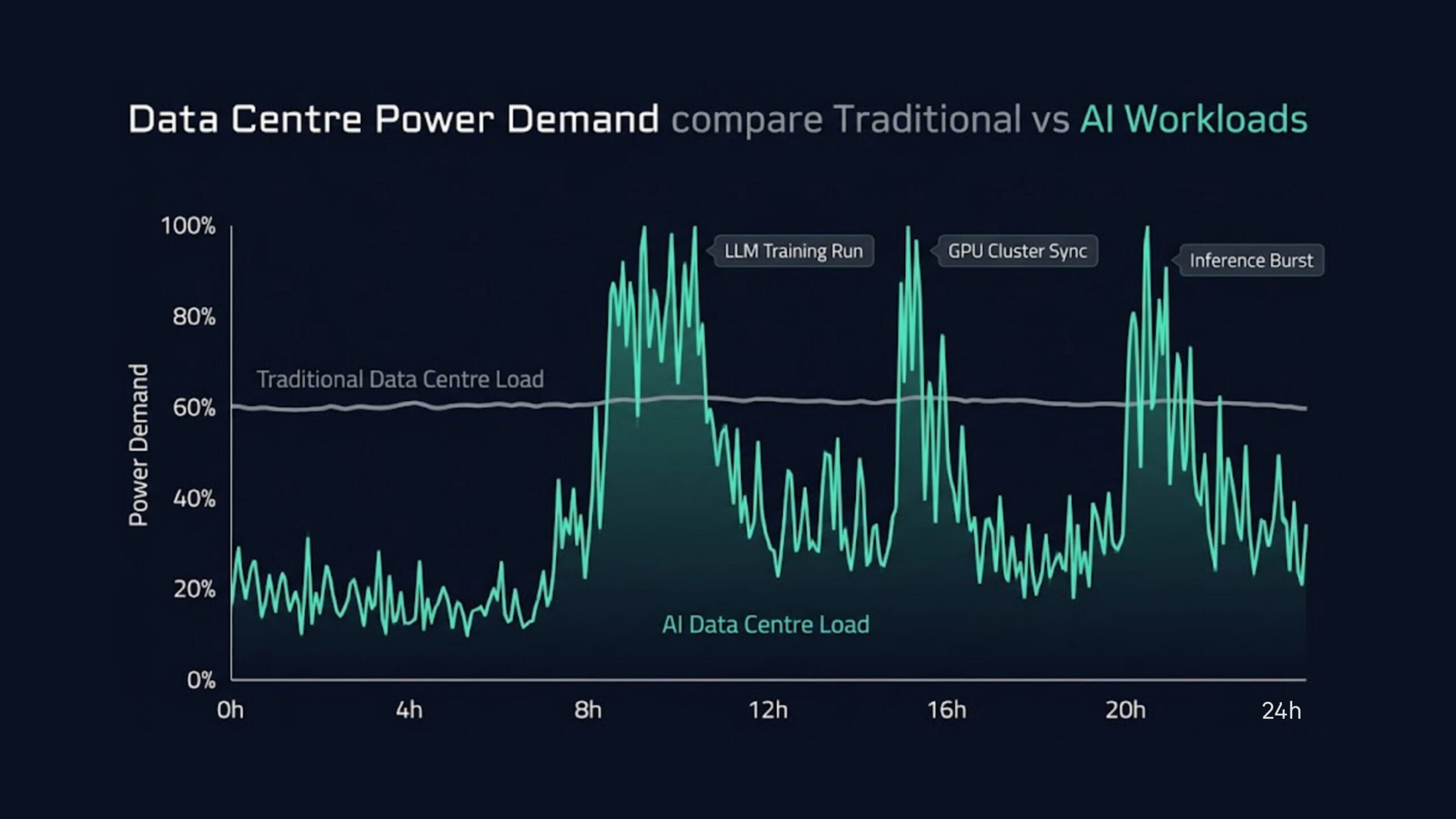
Every time a large language model trains, every time a GPU cluster spins up a new inference job, a wave of electricity surges through a data centre’s power infrastructure that would have been unthinkable a decade ago. We are not talking about gradual ramp-ups. AI workloads generate highly variable demand patterns with load swings of 40% or more, concentrated power densities exceeding 150 kW per rack, and computational bursts that can stress both grid connections and backup power systems simultaneously. Traditional infrastructure was never designed for this.
The answer the industry is converging on is battery energy storage — but not just any battery. The real question is what sits on top of the hardware. Because in a world where a single data centre outage can cost more than a million dollars, the intelligence managing those batteries matters as much as the cells themselves.
The AI Power Problem Is Different in Kind, Not Just Degree
Traditional data centres were predictable customers. Enterprise applications, cloud storage, and content delivery networks operate with demand variations typically limited to 10–15% of total capacity. Substack Legacy power infrastructure — including conventional UPS systems — was sized and optimised around that predictability.
AI changes everything. Modern AI data centres run massive parallel workloads across thousands of GPUs and accelerators, synchronised through high-speed interconnects. The synchronised interaction between GPUs causes massive power demand fluctuations and dangerous transient conditions in the supply network or microgrid. Pipeline and Gas Journal No amount of diesel generator or conventional UPS can absorb those microsecond-level swings.
The numbers confirm the urgency. In 2024, data centres consumed over 400 terawatt-hours of electricity — around 1.5% of all usage worldwide — and this figure is expected to more than double by the end of the decade, reaching 945 TWh. Pipeline and Gas Journal A U.S. Department of Energy report released in July 2025 warns that the combination of considerable load growth and the decommissioning of stable power capacity could elevate the likelihood of power outages by a factor of 100 by 2030. Bimergen This is not a distant risk — it is a planning reality for anyone building or operating data centre infrastructure today.
BESS: From Backup Accessory to Mission-Critical Infrastructure
For years, batteries in data centres meant UPS — a few minutes of ride-through while generators spun up. That era is over.
Strategically, BESS is shifting from a backup accessory to core infrastructure. Operators are deploying battery energy storage systems to smooth peaks, reduce reliance on fossil-fuel backup, and support deeper integration of renewables. DataCenterKnowledge
The shift is being driven by several converging pressures:
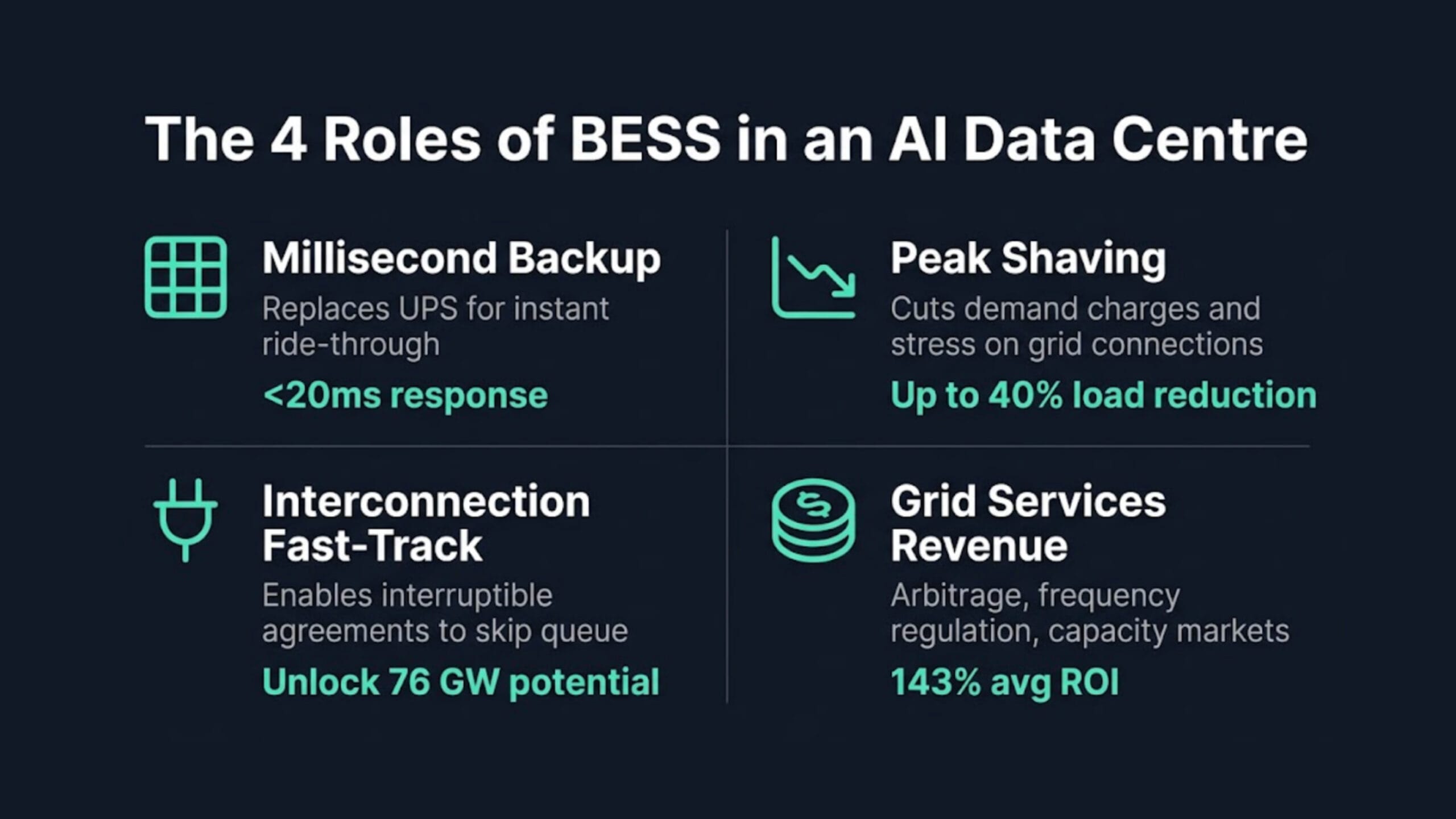
The interconnection bottleneck. Long interconnection queues with utilities are notorious for delaying project timelines. However, if developers opt for an interruptible interconnection agreement and leverage batteries to ensure stable, uninterrupted power, they can gain approval faster and bring capacity online sooner. Newer models suggest this flexible, interruptible strategy could unlock up to 76 GW of new capacity for data centre development in the US alone.
Load smoothing as a technical necessity. BESS systems with rapid response capabilities — the ability to inject or absorb power near-instantaneously — are ideally suited for peak shaving and power smoothing in data centres. With BESS in a grid-forming configuration, inverters can quickly detect frequency changes, mitigating the impact of transients on power quality. Pipeline and Gas Journal In essence, BESS acts as a “virtual” spinning reserve, ensuring stability during periods of high demand, such as during large language model training runs. Pipeline and Gas Journal
Cost reduction and revenue generation. BESS not only enables data centre owners and operators to lower their overall energy costs, but batteries can also unlock new revenue streams by participating in power markets — buying electrons when they are plentiful and cheap, and using those stored electrons later when grid power becomes more constrained and expensive.
The market is responding accordingly. Global combined installations of grid-scale and behind-the-meter BESS reached approximately 315 GWh in 2025, a growth of around 50% year-on-year. Over 150 giga-scale projects are currently in the pipeline for 2026. Bimergen By 2030, global shipments of AI data centre energy storage lithium-ion batteries are projected to exceed 300 GWh, reflecting robust long-term growth momentum. Energy-Storage.News
The Three Imperatives of Data Centre-Grade BESS
Industry analysts and operators agree that AI data centres require BESS that meets three core demands:
Full-duration supply — the ability to absorb surplus green power and secure base load; high reliability — handling instantaneous peak loads and maintaining 99.9%+ availability; and cost efficiency — optimising energy costs to enhance operational margins. Energy-Storage.News
Meeting all three simultaneously is where conventional BESS management falls short. Hardware alone cannot deliver this combination. Most commercial BESS systems are not optimised for load smoothing in modern data centres — they are designed for grid applications, which necessitate relatively low charge/discharge rates and large energy storage capacities. Pipeline and Gas Journal Deploying a grid-optimised battery stack in a hyperscale AI facility is like installing a freight train engine in a Formula 1 car: the power is there, but the control system isn’t built for what the application actually demands.
This is precisely the gap that AI-driven battery management was designed to close.
EVE-Ai: The Intelligence Layer That Data Centres Actually Need
Electra’s EVE-Ai platform was built around a fundamental insight: a battery that cannot report its true state accurately is a liability, not an asset. In data centre contexts, where the margin between operation and outage is measured in milliseconds, that insight becomes critical infrastructure.
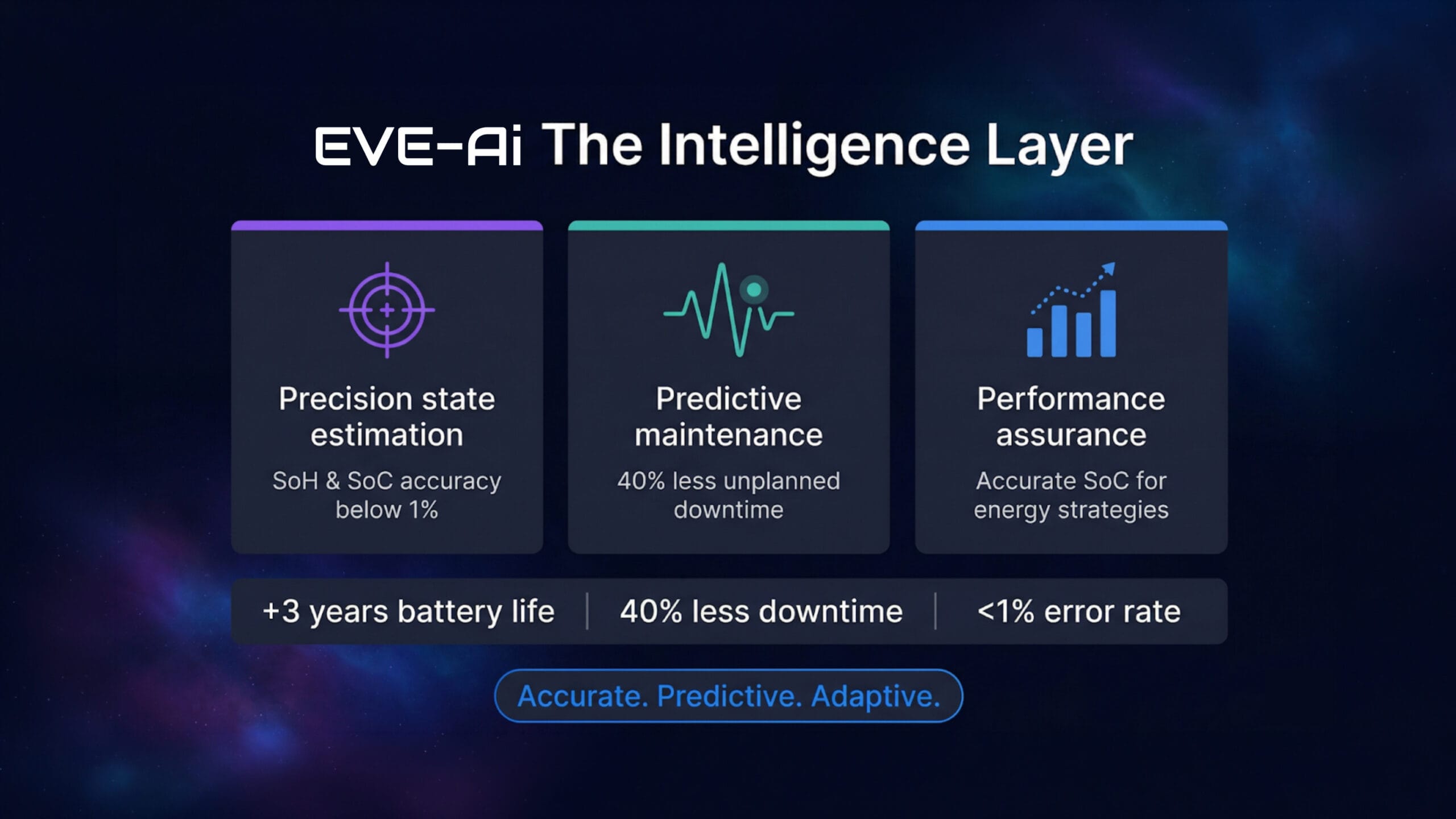
EVE-Ai brings three capabilities that matter specifically for data centre BESS deployments:
- Precision state estimation in real time. EVE-Ai’s adaptive controls deliver state-of-health (SoH) and state-of-charge (SoC) accuracy below 1% and state-of-power error below 5%. In a dynamic AI workload environment — where GPU clusters surge and throttle unpredictably — knowing the exact usable capacity of your battery at any moment is the difference between riding through a grid event and going dark. Operators who rely on standard EMS monitoring are navigating with a blurry map. EVE-Ai provides sub-metre precision.
- Predictive maintenance before failures cascade. Data centre operators cannot afford to discover a battery degradation problem during an outage. EVE-Ai’s predictive analytics identify anomalies and degradation patterns weeks or months before they become critical — reducing unplanned downtime by up to 40% and extending battery life by up to three years. For a multi-million-dollar BESS installation serving mission-critical compute, the ROI on that foresight is not incremental; it is existential.
- Performance assurance for energy strategies. When data centre operators run energy arbitrage or participate in grid services markets, the strategy is only as good as the battery data behind it. EVE-Ai provides the accurate, real-time SoC and SoH visibility that ensures those strategies actually perform — protecting both asset lifetime and financial returns. Operators don’t just store energy; they store it with confidence.
Taken together, these capabilities transform a BESS installation from a passive energy buffer into an active, intelligent asset that earns its cost every day it operates.
The Compounding Cost of Flying Blind
BESS can be co-located at the data centre or deployed at the transmission level, offering both behind-the-meter and grid-level flexibility. Whichever configuration a data centre operator chooses, the economic logic is the same: the value of that investment depends almost entirely on how well it is managed — through real-time analytics, continuous state monitoring, and software-driven optimisation that keeps every charge cycle aligned with both grid conditions and asset health.
Without these capabilities, battery operators face compounding risks. Inaccurate SoC readings lead to over-discharging, which accelerates cell degradation. Undetected thermal anomalies create safety risks. Missed arbitrage windows leave revenue on the table. And in the worst case, an unmonitored failure during a peak load event triggers exactly the kind of cascade outage that BESS was installed to prevent.
The intelligence gap is not a minor operational detail. Given that a single data centre outage can exceed $1 million in losses, and that BESS installations themselves represent multi-million-dollar capital commitments, operating without AI-driven oversight is an asymmetric risk that no serious operator should accept.
Choose Intelligent Storage — Before the Grid Decides for You
The window for treating BESS as an optional upgrade is closing. U.S. data centre demand is projected to quadruple by 2030. Over 150 giga-scale storage projects are already in the pipeline for 2026. The AI economy is being built on battery infrastructure — and the operators who win will be those who deploy batteries that think.
Electra’s EVE-Ai is purpose-built for this moment. Whether you are a data centre developer evaluating co-located BESS, a utility-scale operator managing behind-the-meter storage for hyperscale clients, or an energy investor assessing the performance of your BESS portfolio — EVE-Ai provides the intelligence layer that turns storage into a precision asset.
Accurate. Predictive. Adaptive. EVE-Ai is the brain for batteries that the AI era demands.